


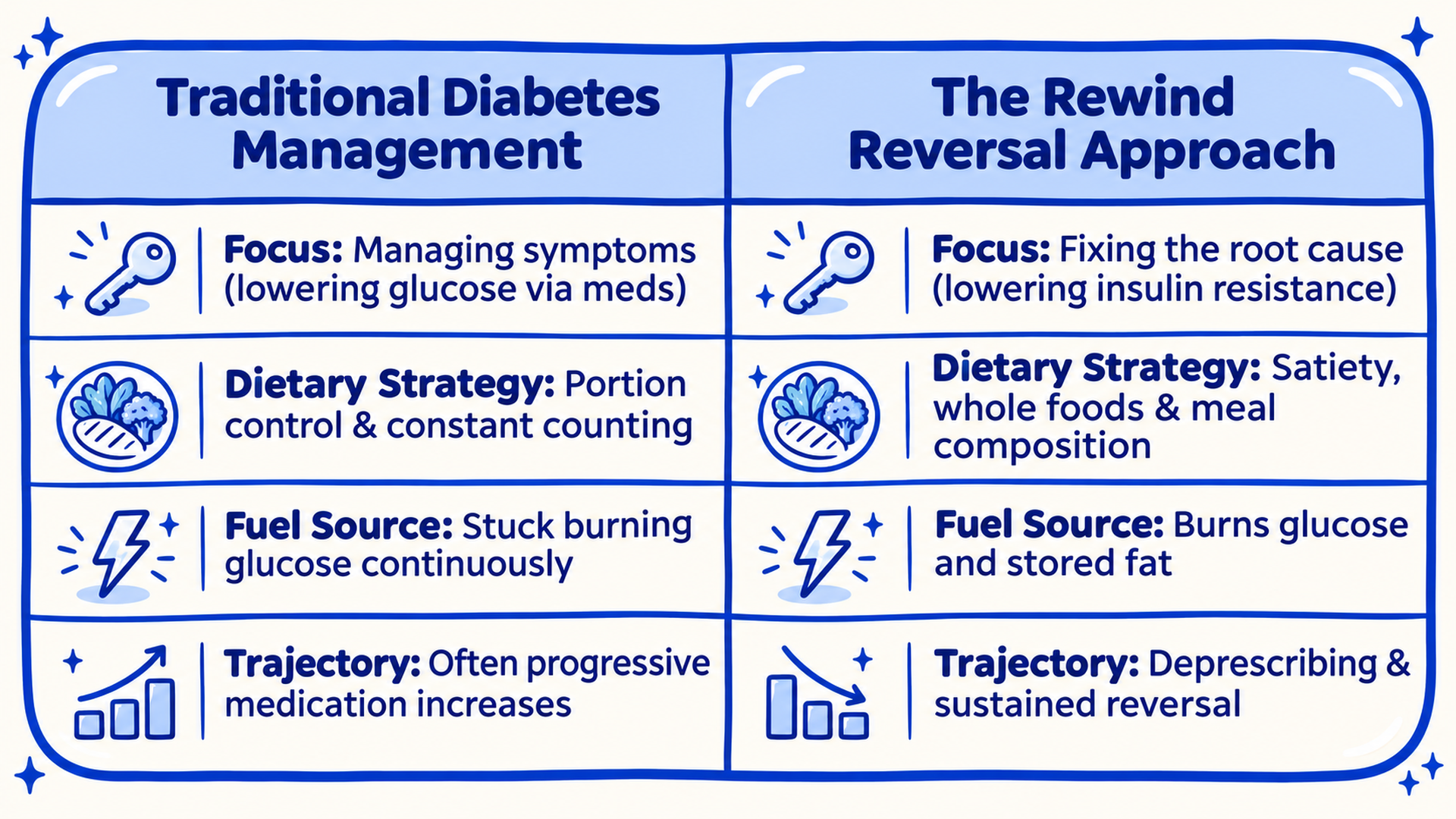
If you have been diagnosed with type 2 diabetes or prediabetes, you may have been told that it is a chronic, progressive disease. You may have also been told it is something you can only hope to manage with an ever-increasing list of medications. For decades, standard care focused primarily on treating the symptom (high blood sugar) rather than fixing the underlying root cause (metabolic dysfunction). But modern metabolic science paints a very different picture: Type 2 diabetes is reversible. At Rewind, our protocol isn't built on temporary diets or quick fixes. It is grounded in physiology, endocrinology, and behavioral science. We work with your body's natural biology to restore metabolic flexibility, lower insulin resistance, and help you safely reduce or eliminate dependency on medications.
Here is a look behind the scenes at the science of reversal and the three key mechanisms Rewind uses to help you reclaim your health.
To understand how Rewind works, it helps to understand what causes type 2 diabetes in the first place. It isn't simply a matter of eating too much sugar; it is a breakdown in how your body processes and stores energy. When you eat carbohydrates, your body breaks them down into glucose, which enters your bloodstream. In response, your pancreas produces insulin which is the key that unlocks your cells so glucose can enter and be used for energy.
When cells are constantly flooded with glucose and insulin, they essentially have no choice but to “change the locks.” This is what we refer to as insulin resistance. To compensate for the changing of the locks, your pancreas pumps out even more insulin to force glucose into resistant cells. Over time, high levels of circulating insulin signal your body to store fat (particularly in the liver and around abdominal organs) while preventing you from tapping into stored fat for fuel.
How Rewind Intervenes
The Rewind protocol lowers the glucose burden entering your system. By prioritizing nutrient-dense whole foods, essential proteins, and healthy fats while reducing refined carbohydrates, we lower the demand for insulin.
When circulating insulin levels drop:
Healthy metabolism isn't rigid; it is flexible. A metabolically healthy body operates like a hybrid vehicle: it can effortlessly switch between burning carbohydrates from your last meal and burning stored body fat when food isn't present. In type 2 diabetes, metabolic flexibility is lost. Because insulin levels remain chronically high, the body stays stuck in "carbohydrate-burning mode." Even if you have abundant stored energy in the form of body fat, high insulin acts as a biological lock, preventing your body from accessing that energy. This is why you might feel fatigued or intensely hungry even shortly after eating.
As metabolic flexibility returns, energy slumps disappear, food noise decreases, and blood sugar levels stabilize naturally.
Knowing what to do is only half the equation; having the structure, clinical oversight, and daily support to do it consistently is where real transformation happens. The human body is complex, and no two metabolic profiles are identical. What causes a blood sugar spike in one person might produce a stable curve in another. That is why static, one-size-fits-all diabetes advice often fails over the long term.
Behind the scenes, Rewind pairs personalized data with dedicated human care:
